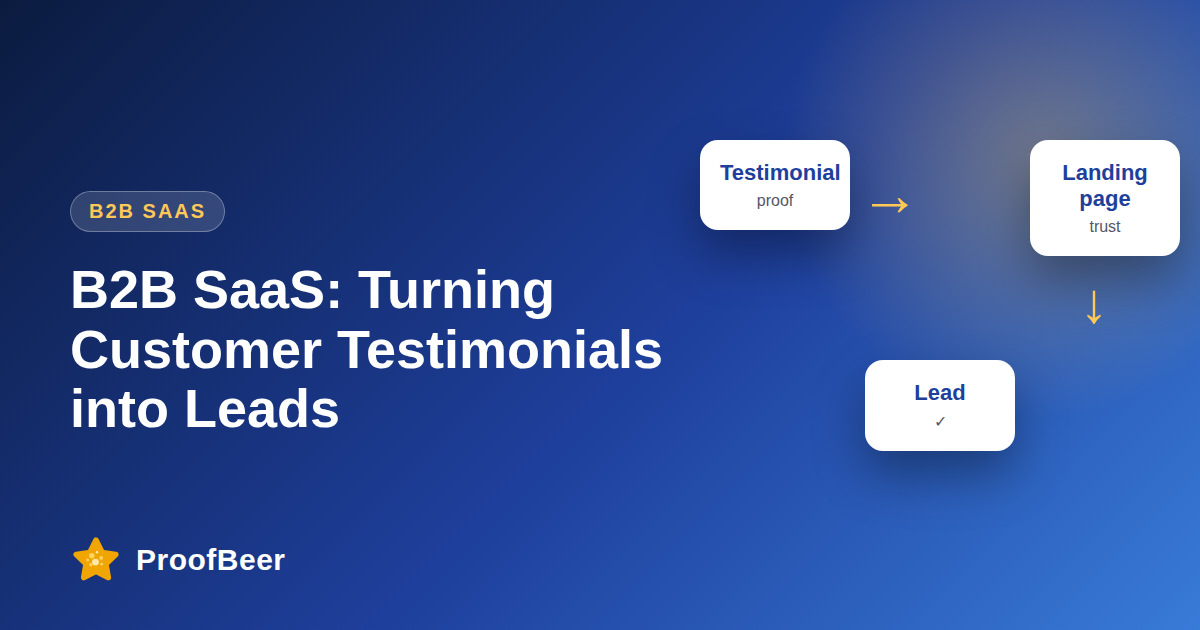
To turn B2B testimonials into leads, pick happy customers after a renewal or expansion, ask specific questions about their challenge and results, build case studies with quantified outcomes, and repurpose them in sales decks, on your homepage, in email and on LinkedIn. Always get written approval and use real names, roles and metrics.
- B2B buyers face committee decisions and risk, so specific proof of results matters more than generic praise.
- The best moments to ask are after a renewal, an expansion, a successful launch or a positive support interaction.
- Open questions about challenges, alternatives considered and measurable results produce far better quotes than 'what do you think?'.
- A strong case study covers company, challenge, solution, results and a named quote with title.
- Only publish numbers that the customer has confirmed and approved in writing.
- One interview can be repurposed into a case study, a short quote, a video clip, an email and a LinkedIn post.
- Update proof at least once a year, because outdated case studies weaken credibility.
- Structured, first-party case study pages are easy for AI search engines to cite when they contain clear facts and attributions.
Which customers should you ask first?
- Start with customers who recently renewed, because renewal shows continued value in practice.
- Ask customers who expanded seats or added products, since growth is a strong signal of satisfaction.
- Approach customers who referred others or posted positive public reviews, as they have already shown willingness to advocate.
- Include different company sizes and industries so that prospects find someone similar to themselves.
- Coordinate with account managers so you do not interrupt sensitive renewals or open support issues.
How do you ask for specific details?
- Avoid vague questions such as 'what do you think?', which produce vague answers.
- Ask 'What was your biggest challenge before using the product?' to capture the starting point.
- Ask 'How has this saved you time or money?' and request a number the customer is comfortable sharing.
- Ask 'What made you choose us over other options?' to learn the buying criteria that matter.
- Ask 'Who on your team uses it, and for what?' so prospects can picture their own team.
What belongs in a B2B case study?
- Name the company, industry and size, and add a logo only with permission.
- Describe the challenge in the customer's own words, including what they tried before.
- Explain the solution and how it was implemented, so readers see the path to results.
- Report results with numbers that the customer has verified, plus the time period measured.
- End with a quote that has a full name, title and company, and a clear next step for the reader.
How can you repurpose one testimonial?
- Add the best quote and logo to the sales deck so reps can use them in live conversations.
- Feature a short version on the homepage or pricing page where buying decisions are made.
- Include the case study in email nurture sequences for leads in a similar industry.
- Turn the story into LinkedIn posts, and tag the customer only with their agreement.
- Use the quote in ads or landing pages after confirming that the permissions cover paid use.
What best practices raise credibility?
- Use real metrics, and describe how they were measured so readers can trust them.
- Collect video when possible, because faces and voices add authenticity.
- Keep a record of written approvals with dates, scope and the person who approved.
- Update each case study every year and note the last updated date.
- Track which proof assets appear in deals that close, then create more of that type.
Step-by-step: how to do this with ProofBeer
Select five to ten happy customers using renewals, expansions and public praise as signals.
Send a short request that explains the time needed and how the story will be used.
Hold a 20 to 30 minute interview using prepared questions about challenge, solution and results.
Draft the case study and send it to the customer for factual checks.
Get written approval for the name, quotes, metrics and logo.
Publish the page, then share it in sales decks, email and on LinkedIn.
Measure leads, conversion and influence on deals, and refresh the proof every year.
Common mistakes to avoid
Metrics to track
Leads generated from pages that feature testimonials or case studies.
Conversion rate on pages with proof compared with similar pages without it.
Number of proof assets used by the sales team each quarter.
Influence of case studies on deal progression, as reported by sales.
Number of approved customer stories published each year.
Quick checklist
Examples and templates
'Would you spend 20 minutes sharing how our product has changed your reporting process?'
Challenge, Why they chose us, Implementation, Results, Quote, Next step
full page, sales deck slide, homepage quote, email snippet, LinkedIn post
- Ask for the number the customer is proud of, not the one you expect
- Send the draft before publishing so there are no surprises
- Keep a spreadsheet of approvals and the date each story should be refreshed
How ProofBeer Helps You Grow
Collect testimonials with a branded form and moderate them in one dashboard, with consent recorded at submission.
Display testimonials in a Wall of Love or spotlight slider on your homepage and pricing page.
Tag testimonials by industry or use case so sales can share the most relevant proof with each prospect.
Frequently Asked Questions
How do I get B2B testimonials?
Ask satisfied customers at natural moments such as after a renewal or successful launch. Use specific prompts about challenges and measurable results, make replying easy with a short form or a call, and explain exactly where the testimonial will appear.
What makes a good B2B case study?
A good case study shows the customer's challenge, your solution and results with numbers, backed by a named quote. It should be specific, honest and approved by the customer, with enough detail that a similar company can recognise itself.
Do I need customer permission to publish a testimonial?
Yes. Get written permission for the name, title, company, logo, quotes and any numbers. Keep the approval on file, and follow applicable rules on endorsements such as the FTC Endorsement Guides in the United States.
How many case studies should I start with?
Start with three to five covering your main customer types or industries. That is enough to support sales conversations and your site. Add new ones as you win more customers and retire stories that no longer reflect your product.
Where should I use B2B testimonials?
Use them on your homepage, pricing and product pages, in sales decks and proposals, in nurture emails, on LinkedIn and in landing pages for ads. Place proof next to the decision it supports, such as a pricing or demo button.
How do I measure the impact of testimonials?
Track conversion rate on pages with proof, leads from case study pages, and how often sales uses each asset. Ask sales which stories help close deals, and compare results across industries and company sizes over a quarter or more.
Conclusion
Specific, approved and quantified proof turns testimonials into a lead engine. Pick the right
customers, ask better questions and reuse each story across your sales and marketing channels.
- HubSpot or Gartner B2B research
- FTC Endorsement Guides