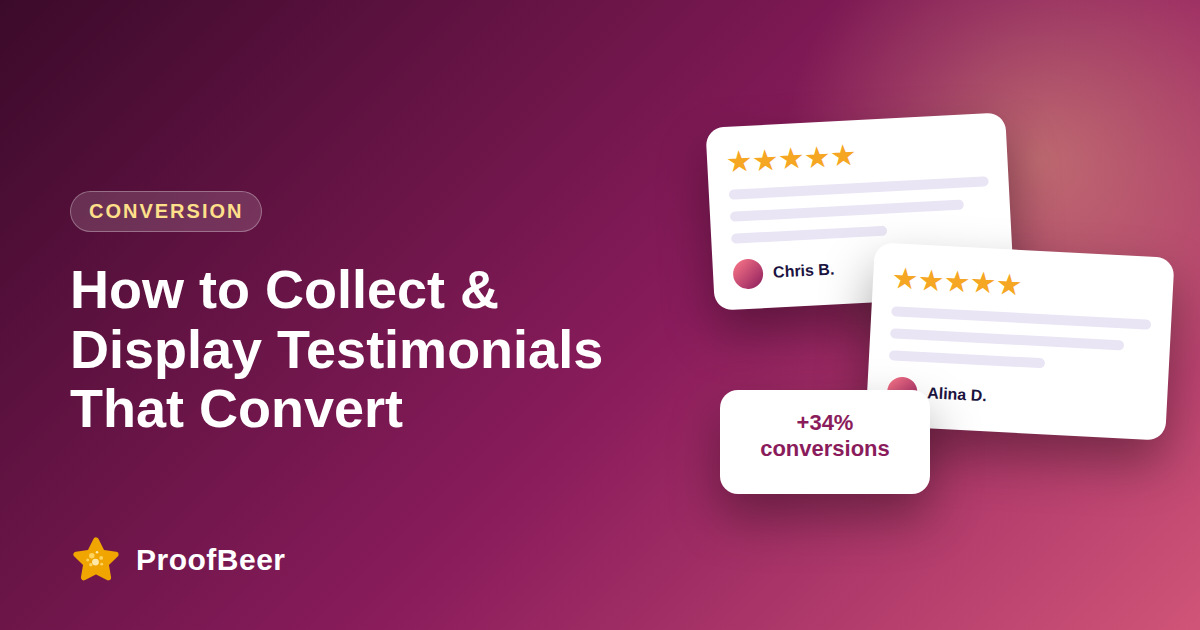
To collect testimonials that convert, ask customers at moments of delight, use specific narrative questions, offer text, star and video formats, then place the best quotes where buyers hesitate: under the hero, beside pricing, near checkout and on a Wall of Love. Specific results beat generic praise.
- Buyers judge risk before features, and social proof reduces perceived risk.
- Ask at delight moments: after onboarding, first result, delivery or a renewal.
- Specific questions get specific, believable testimonials.
- Display proof at friction points, not only on a hidden testimonials page.
- Refresh and measure: test placement and format every month.
What is social proof?
Social proof is the tendency to look at what other people do and say when we are unsure what to do ourselves. Online, it appears as reviews, star ratings, testimonials, case studies, customer counts, expert endorsements and social media mentions. It matters because visitors cannot touch or try your product before they commit. They judge the risk from signals about other people's experience, and the strongest signals come from people who look like them. (Related: /glossary/social-proof)
What the research says
Two sources give a useful picture.
Northwestern University's Spiegel Research Center found that products with five reviews were 270% more likely to be purchased than products with none, and that for higher-priced products the lift was 380%. The benefit of each additional review shrinks quickly after the first five. Purchase likelihood tends to peak when the average rating is between 4.0 and 4.7 and then falls as it approaches 5.0, which suggests shoppers distrust perfect scores. Identifying verified buyers raised purchase likelihood by 15% in the study.
BrightLocal's 2026 Local Consumer Review Survey (1,002 US adults) found that 97% of consumers read reviews for local businesses, 74% focus on reviews from the last three months and 49% trust online reviews as much as personal recommendations. It also reported that 85% are more likely to use a business with positive reviews.
What this means for you: you do not need hundreds of reviews to start. The first handful matter most, freshness matters, and authenticity beats perfection.
The six types of social proof
(Use an HTML table, then one paragraph per type.) Type | What it is | Best placement | Example Customer testimonials | Quotes with name, role and photo | Landing and pricing pages | "We cut onboarding from six weeks to two." - Name, Role Reviews and ratings | Stars and text from Google, Facebook, Trustpilot | Product, service and location pages | 4.8 from 312 Google reviews Case studies | Detailed stories with numbers | Sales pages, email | Before and after metrics Expert or influencer proof | Endorsements from credible people | Hero, press page | "Recommended by..." Social media content (UGC) | Tagged posts and mentions | Wall of Love, product pages | Customer photos Numbers and crowd proof | Customer counts, usage stats | Hero, footer | "Used by 12,000 teams"
Testimonials are controlled and can be chosen to answer specific objections. Use quotes that name a result and a person, not "great product". Reviews and ratings come from outside sources and carry more independent weight; sync them from the platforms your customers already use. Case studies suit higher-priced or complex purchases where a visitor wants the full story. Expert and influencer proof borrows trust, so choose people your audience respects and disclose any payment or free product. Social media content shows real people using your product; always get permission before featuring someone's post. Numbers work when they are specific, current and verifiable; "12,418 customers" reads more credibly than "thousands".
Social proof for different types of business
Ecommerce stores benefit most from product-page reviews with photos, a rating near the add-to-cart button and Google or Facebook reviews on the home page. See /solutions/ecommerce and /integrations/website-platforms/shopify.
SaaS companies lean on customer logos, case studies, review-site badges and onboarding feedback that proves value quickly. See /solutions/saas.
Local businesses win with Google reviews, QR codes at the counter or on receipts, and Facebook recommendations on their site. See /solutions/local-business.
Agencies and freelancers need case studies and client testimonials that mention results, plus a simple way to collect them from every client. See /solutions/agencies.
Course creators and newsletter writers rely on student results, subscriber counts and a Wall of Love that is easy to update. See /solutions/creators and /solutions/newsletters.
Where to place social proof
Put proof where hesitation is highest. A rating and review count near the top of the home page answers the first trust question. One strong quote directly under the primary call to action supports the click. On pricing pages, place testimonials that address price and support next to the plans. On checkout or booking pages, keep proof short and close to the button, together with any guarantee. Above contact forms, a rating badge reduces the fear of being ignored. In email, repeat the same quote that appears on the landing page so the message is consistent.
One strong element at each decision point works better than a wall of quotes everywhere. See /blog/widget-placement-science-high-intent-locations.
Rules for honest social proof
In the United States, the FTC's Consumer Reviews and Testimonials rule took effect on 21 October 2024 and allows civil penalties for knowing violations. It covers fake reviews, buying positive reviews on third-party platforms, suppressing negative reviews through false claims or threats, and undisclosed insider reviews. In practice:
- Never write, buy or invent reviews or testimonials.
- Do not remove negative reviews by false accusation or intimidation. Reply publicly instead.
- Incentives are allowed only where there is no requirement that the review be positive, and Google prohibits incentives for its own reviews.
- Get written or recorded permission for names, photos and video.
- Disclose relationships such as employees, family, paid endorsements and free products.
- Keep claims you can substantiate and results that are typical or clearly qualified.
Other countries have their own rules, for example the GDPR for personal data. This is general information, not legal advice.
How to measure social proof
Measure before and after. Useful metrics include conversion rate on pages with and without proof, click-through on calls to action near widgets, form completion rate, bounce rate, monthly review volume, review recency, average rating and Net Promoter Score. Run A/B tests that change one element at a time, keep traffic split evenly and wait until each variant has enough conversions before you decide. See /blog/ab-testing-social-proof-conversions. Do not promise a fixed uplift to yourself or anyone else; results vary by audience and offer.
A 30-day social proof plan
Week 1: audit what you have. List your best five quotes, reviews and case studies, and check permission for each. Week 2: build a feedback form and a review link, then automate a request after purchase or onboarding. Week 3: connect Google and Facebook, and place one widget each on the home page, pricing page and one key product or service page. Week 4: measure, test one variation, reply to every review and schedule the next round of collection.
How to collect better testimonials
- Trigger at moments of delight: course finished, shipment received, first win.
- Ask narrative questions: 'What hesitations did you have, and what results have you seen?'
- Offer formats: 2-sentence note, star rating, 30-second video.
- Get consent to publish and keep a record.
- Moderate and tag by use case, industry and outcome.
How to write a high-converting testimonial prompt
- Challenge: 'What problem were you trying to solve?'
- Decision: 'Why did you choose us?'
- Result: 'What changed? Any numbers?'
- Recommendation: 'Who should use this?'
- Permission: 'May we publish your name, photo and company?'
Step-by-step: how to do this with ProofBeer
Map your customer journey and mark three delight moments.
Create a ProofBeer form with the five prompts above.
Automate the request to send at each delight moment.
Moderate, tag and approve submissions.
Place widgets on hero, pricing, checkout and a Wall of Love.
Review results monthly and rotate quotes.
Common mistakes to avoid
Metrics to track
Testimonial request response rate.
Number of testimonials with a measurable result.
Conversion on pages with proof.
Time from submission to publication.
Quick checklist
Examples and templates
What problem were you trying to solve?
Why did you choose us?
What changed, with numbers if possible?
Who would you recommend us to?
- Ask for numbers: 'saved 5 hours a week' beats 'saved time'
- Show full name, role and company when consented
- Rotate testimonials monthly
How ProofBeer Helps You Grow
AI-powered forms for text, rating and video testimonials.
Auto-aggregation of Google and Facebook reviews into one dashboard.
Masonry walls, marquees and badges you can embed in minutes.
Frequently Asked Questions
How many testimonials do I need?
Start with three to five specific ones. Research shows the largest gains come from the first few reviews.
Are reviews or testimonials better?
Reviews from independent platforms usually carry more weight; testimonials are controllable and can target specific objections. Use both.
Does social proof help SEO?
Indirectly, through conversion and engagement. Star snippets in search are restricted for reviews that a business controls about itself; see /blog/rich-snippets-schema-markup-reviews.
What is the best social proof for a new business?
Early customer quotes with names and results, a few genuine reviews and a clear founder story.
How do I collect testimonials from customers?
Send a short request at a moment of delight, ask 3-4 specific questions, and let people choose text, star rating or video. Automate it so every customer is asked.
What makes a testimonial convincing?
A named person, a specific problem, a measurable result and a clear recommendation. Generic praise such as 'Great tool!' rarely persuades.
Where should testimonials go on a website?
Near points of doubt: under the hero, beside pricing, near checkout and on feature pages, plus a dedicated Wall of Love.
How many testimonials do I need?
Start with 10-15 good ones. Quality, specificity and relevance beat raw count.
Do I need permission to publish testimonials?
Yes. Get explicit consent, keep a record, and follow privacy rules and local advertising regulations.
Conclusion
Testimonials convert when they are specific, easy to collect and shown at moments of doubt. Build a repeatable system and keep improving it with data.
- Robert Cialdini - Influence: The Psychology of Persuasion
- Northwestern Spiegel Research Center - 'How Online Reviews Influence Sales'