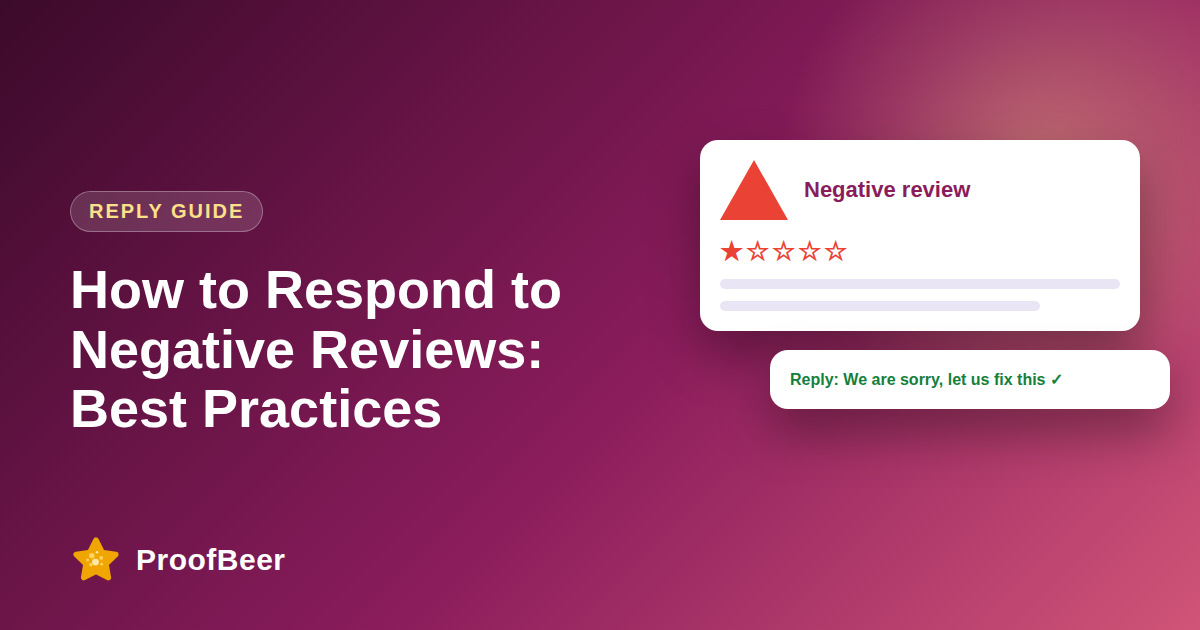
Respond to a negative review in three steps: thank the reviewer and apologise sincerely, invite them to resolve the issue offline with clear contact details, and follow up after you fix it. Keep replies short, personal and professional, and never argue, blame the customer, offer public compensation or reveal private information.
- Prospective customers read your replies, so a calm and helpful response protects your reputation beyond the single reviewer.
- Use a simple three-step framework: acknowledge and apologise, take the conversation offline, then follow up and learn.
- Respond quickly, ideally within one or two business days, and sooner for serious complaints.
- Personalise each reply with the customer's name and a specific detail instead of pasting the same text.
- Apologise for the experience without admitting fault you cannot verify.
- Never share private customer details, order information or health data in a public reply.
- Report fake, abusive or policy-breaking reviews through the platform instead of arguing publicly.
- Look for patterns across negative reviews and feed them back to operations and product teams.
How do you acknowledge and apologise?
- Thank the reviewer for taking the time to share their experience, even when the tone is harsh.
- Apologise sincerely for how they felt, without sounding defensive or scripted.
- Reference one specific detail from the review to show that you read it.
- Example: 'Thank you for sharing this. We are sorry your experience did not meet expectations, and we would like to make it right.'
- Keep the opening to two or three sentences so the reply stays focused.
How do you take the conversation offline?
- Provide a direct email address or phone number, ideally for a named person who can solve the problem.
- Invite the customer to contact you with their order or booking details through the private channel.
- Avoid negotiating, explaining a refund or arguing the facts in public.
- Example: 'Please contact us at support@yourcompany.com so we can resolve this personally.'
- Offer a clear next step so the customer knows what to expect.
How do you follow up and learn?
- Resolve the issue promptly and confirm with the customer that it is fixed.
- Ask what went wrong so you can understand root causes, not only symptoms.
- Share the lesson with the team and update any process or training that caused the problem.
- If the customer is happy, you may politely mention that they are welcome to update their review, without pressure.
- Record the issue in your theme tracker so repeated problems become visible.
What do good reply templates look like?
- Service issue: 'We are sorry we fell short on service. Please contact our manager so we can look into what happened.'
- Product quality: 'We are sorry the product did not meet expectations. Please email your order number so we can help.'
- Delivery: 'We apologise for the delay. Please share your order details and we will check the status right away.'
- Replace placeholders with real names and contact information before posting.
- Adapt the wording so that no two replies on the same page sound identical.
What are the key dos and don'ts?
- Do respond quickly, use the customer's name and stay professional at all times.
- Do keep the reply short enough to read on a phone screen.
- Do not be defensive, sarcastic or dismissive, even when the review seems unfair.
- Do not blame the customer, reveal private information or offer public compensation.
- Do not ask for a changed review under pressure, and follow platform rules on incentives and review removal.
Step-by-step: how to do this with ProofBeer
Monitor all review sources so you see new negative reviews quickly.
Read the review carefully and decide the facts you can verify.
Draft a reply using the three-step framework with an apology, an offline contact and a next step.
Personalise the draft with the customer's name and one specific detail.
Post the reply and send an internal note to the person who will handle the case.
Contact the customer offline, resolve the issue and confirm the outcome.
Record the lesson and add the theme to your monthly review.
Common mistakes to avoid
Metrics to track
Median time from review posted to reply sent.
Share of negative reviews that receive a reply.
Number of issues resolved after the offline contact step.
Number of reviews updated or amended by customers after resolution.
Recurring themes found in negative reviews each month.
Quick checklist
Examples and templates
'Thank you for telling us, Alex. We are sorry the service fell short. Please contact Sam at support@yourcompany.com so we can make this right.'
'We are sorry the product did not meet your expectations, Priya. Please email your order number so we can look into it.'
'We apologise for the delay, Jordan. Please share your order details so we can check what happened.'
- Read the reply aloud and remove any sentence that sounds defensive
- Never include order numbers or personal details in a public reply
- Wait a short time before replying if the review makes you angry
How ProofBeer Helps You Grow
Review alerts notify you quickly when new reviews arrive so you can respond on time .
Reply templates and a response workflow help your team keep a consistent tone while still personalising each message .
Reports show response times and common themes so you can follow up on patterns.
Frequently Asked Questions
How quickly should I respond to a negative review?
Aim for one to two business days, and faster for serious issues such as safety or fraud. A timely reply shows that you care, and it limits how long a complaint stands unanswered for prospective customers.
Should I apologise even if I disagree with the review?
Acknowledge the customer's experience and apologise for how they feel without admitting fault you cannot verify. You can say you are sorry the visit fell short and invite them to share details privately so you can check the facts.
Should I move the conversation to private messages?
Yes, in most cases. Offer a direct contact so you can look into the issue without public back-and-forth and without sharing private information. Leave a short public reply so other readers see that you responded.
Can I ask a reviewer to change or remove their review?
Only after you have resolved the issue, and without pressure or incentives. You can say they are welcome to update their review if they feel the problem was fixed. Follow each platform's policies on this.
What should I do about a fake review?
Report it through the platform's tools, explaining why it violates policy, for example that you have no record of the customer. Post a calm, brief public reply if needed, and avoid accusations that you cannot prove.
Do my replies affect other customers?
Yes. Prospective customers often read both the complaint and your reply to judge how you treat people. A respectful, specific response can reassure them, while a defensive one can raise doubts even if the review itself was unfair.
Conclusion
A calm, helpful reply can turn a critic into an advocate and shows every future customer how you
treat people. Acknowledge, move offline, follow up and learn from every complaint.
- Google Business Profile - respond to reviews
- FTC Consumer Reviews and Testimonials Rule