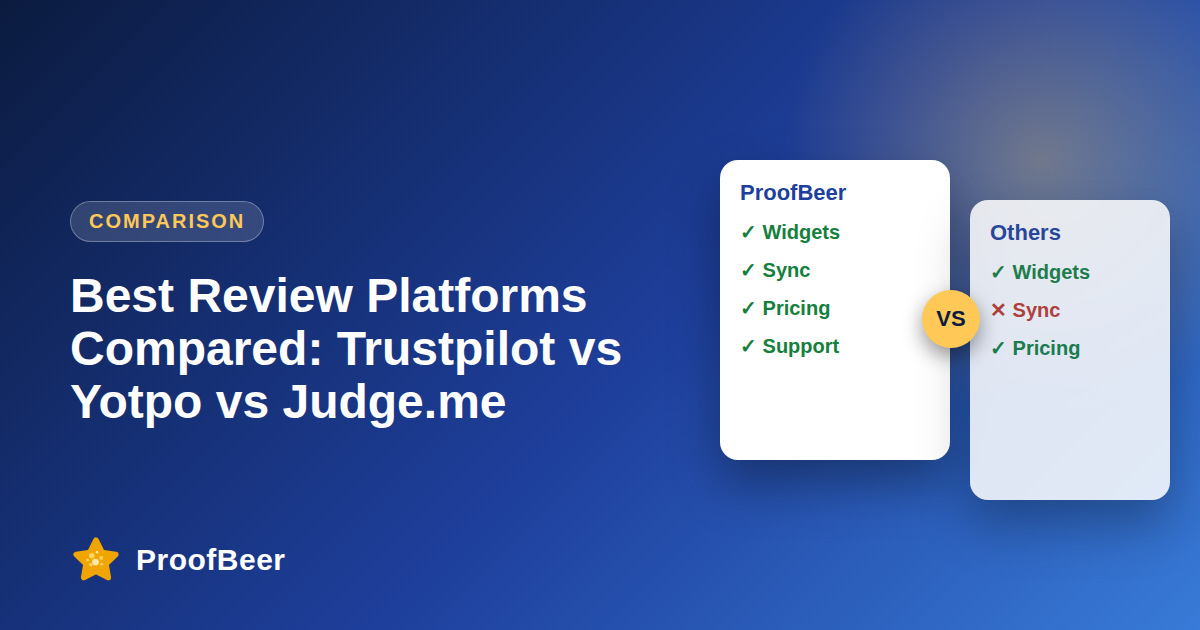
Choose Trustpilot for a public review marketplace and brand trust, Yotpo for an e-commerce suite with user-generated content and loyalty tools, Judge.me for affordable Shopify-focused reviews, and ProofBeer for feedback forms, review sync and fast widgets on any site. Features and prices change, so verify each vendor's current plans before deciding.
- The best platform depends on your business model, budget, sales channels and technical setup.
- Trustpilot is a public marketplace, which can bring consumer recognition but also public scrutiny.
- Yotpo is aimed at e-commerce brands that want user-generated content, loyalty and marketing tools in one suite.
- Judge.me is known as a lower-cost option for Shopify stores.
- ProofBeer focuses on collecting first-party feedback, syncing Google and Facebook reviews and showing fast widgets on any site.
- Compare pricing models, integrations, review sources, widget design, page speed, support and data ownership.
- Test free plans or trials before committing to a long contract.
- Add a 'Checked on' date to any comparison because products change often.
Who is Trustpilot best for?
- Trustpilot is a public review platform that many consumers recognise, so it suits brands that want a visible third-party reputation.
- It is commonly used by e-commerce, service and multi-location businesses that want to collect reviews on a neutral platform.
- Public profiles mean negative reviews are visible, so you need a response process.
- Pricing and features are tiered, so check the current plans and what is included.
- Review the platform's guidelines on invitations and incentives before using it.
Who is Yotpo best for?
- Yotpo targets e-commerce brands that want reviews, photos, videos, loyalty and other marketing tools under one roof.
- Its strength is the breadth of the suite for stores that want to use customer content across channels.
- The trade-off can be cost and complexity, particularly for small teams with simple needs.
- Check which integrations it offers for your store platform and email tool.
- Ask about contract terms, data export and how reviews are displayed for speed and SEO.
Who is Judge.me best for?
- Judge.me is widely used by Shopify stores that want a simple review app at a lower price.
- It can be a good starting point for small stores that need review requests, a widget and basic display options.
- Fewer advanced features may be a limit for larger brands with complex needs.
- Check the current plans, free tier limits and which features are paid.
- Test how its widgets look on your theme and how they affect speed.
Where does ProofBeer fit?
- ProofBeer is designed for SaaS companies, agencies, creators and direct-to-consumer sites that want to collect first-party feedback and show it quickly.
- Its features include feedback forms, syncing of Google and Facebook reviews and lightweight widgets that work on many website platforms.
- It does not have the same public marketplace network as Trustpilot, which is a real difference to consider.
- A free plan may be available.
- It is a good fit if you want to own your review data and display it across your own pages.
How do you compare platforms fairly?
- List your must-have requirements first, such as sources, integrations, widget styles, languages and budget.
- Create a table with rows for best fit, pricing model, integrations, review sources, widgets, page speed and support.
- Link each vendor's own pricing and features pages and add the date you checked.
- Test free plans or trials on a staging page and measure speed and look.
- Ask each vendor about data ownership, export options and contract terms.
What other factors should you consider?
- Consider whether reviews live on your site, on a third-party site or both, because this affects trust and SEO.
- Check whether the platform supports structured data in line with Google's review snippet rules.
- Consider moderation tools, spam detection and verification of real customers.
- Consider support quality, onboarding help and how quickly you can launch.
- Plan for the future: can you switch later and export your reviews without losing them?
Step-by-step: how to do this with ProofBeer
Write down your business model, sales channels, review sources and budget.
List your must-have and your nice-to-have requirements clearly.
Shortlist two or three platforms that match those requirements.
Start free plans or trials and set up a test page with each.
Compare widgets, speed, integrations and ease of use side by side.
Check each vendor's current pricing, contract terms and data export policy.
Estimate the total cost for a year at your expected review volume.
Choose, set up the winner and review the decision after three to six months.
Common mistakes to avoid
Metrics to track
Review volume and response rate after launch.
Conversion rate on pages with widgets.
Page speed and Core Web Vitals before and after.
Total cost per collected review.
Time spent per week managing reviews.
Quick checklist
Examples and templates
Best for, Pricing model, Integrations, Review sources, Widgets, Page speed, Support, Data export, Checked on
'We chose X because it supports Shopify, exports data and costs less than Y for our volume.'
install, import reviews, style widget, measure speed, test mobile
- Never rely on a comparison without a checked-on date
- Ask vendors the same questions in writing
- Revisit your choice every year
How ProofBeer Helps You Grow
Collect first-party feedback with forms and pull in Google and Facebook reviews, giving you one dashboard for your proof.
Use lightweight widgets designed for speed so reviews do not hurt page experience.
Start with a free plan if available so you can test the fit before paying.
Frequently Asked Questions
Which is better, Trustpilot or Yotpo?
They serve different needs. Trustpilot is a public review marketplace, while Yotpo is an e-commerce suite with UGC and loyalty tools. Choose based on your goals, budget and store platform, and verify current features on each site.
Is Judge.me good for small stores?
Judge.me is commonly used by Shopify stores wanting a simple, lower-cost review app. Check the current plans, supported features and how the widgets look on your theme before committing.
Where does ProofBeer fit among these tools?
ProofBeer is aimed at businesses that want feedback forms, Google and Facebook review sync and fast widgets on any site. It has a smaller network than public marketplaces, so consider whether that suits your goals.
Do these platforms offer free plans?
Some offer free plans or trials, but the limits change over time. Check each vendor's pricing page and compare what is included, because free tiers often limit features, volume or branding.
Which platform is best for SEO?
No platform guarantees SEO results. Look for crawlable review text, fast widgets and support for structured data that follows Google's guidelines. Test your pages and measure speed and indexing.
Can I switch platforms later?
Often yes, but it depends on export options and how reviews are displayed. Ask each vendor whether you can export reviews and keep their dates, ratings and attribution before you choose.
Conclusion
There is no single best review platform, only the best fit for your business. Define your needs, test shortlisted tools on your own site and check current pricing and features before you decide.
- Each vendor's pricing and about pages (with date)
- G2 or Capterra category pages