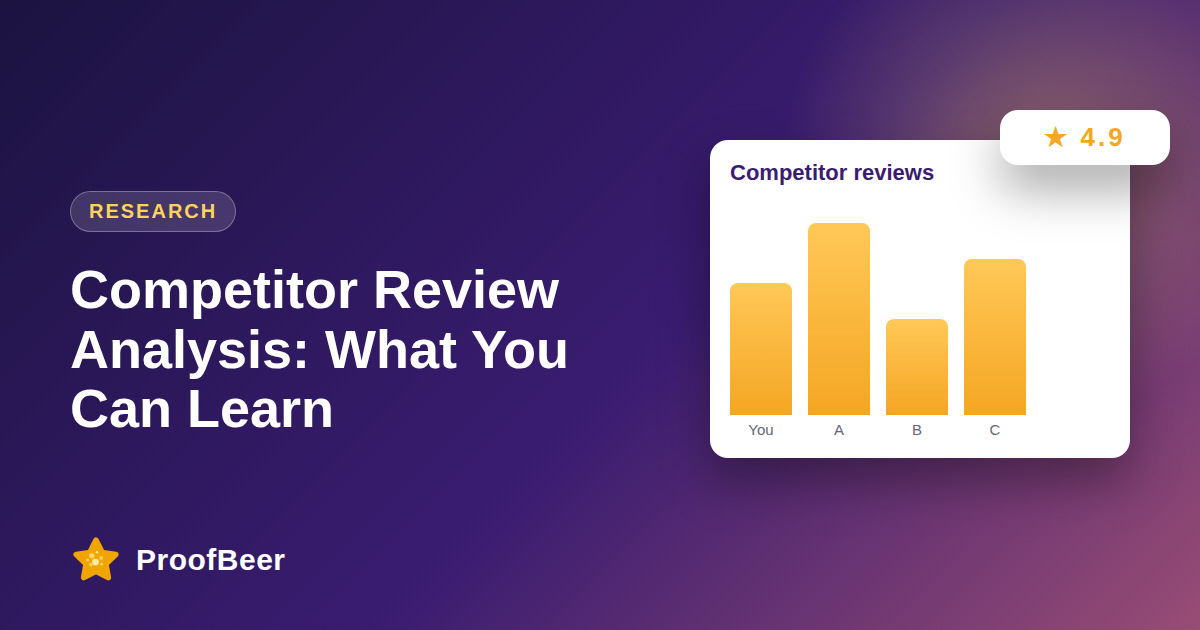
Competitor review analysis means reading public reviews of rival products to learn what customers love, what frustrates them and what they wish existed. Collect a meaningful sample of recent reviews for each competitor, tag them by theme, count the patterns, and turn the biggest gaps into product ideas, messaging angles and sales talking points, while respecting each platform's terms.
- Competitor reviews are a free source of customer language, so they show you the exact words buyers use to describe problems and benefits.
- A consistent set of themes such as pricing, support, ease of use and reliability lets you compare competitors fairly.
- Counting how often each theme appears is more reliable than relying on a few memorable reviews.
- The most useful reviews are often the three-star and four-star ones, which tend to be balanced and specific.
- Always read the platform's terms of use before collecting reviews, and avoid scraping where it is prohibited.
- Do not copy competitor review text into your marketing or claim that customers said things they did not say.
- Turn each finding into an action, such as a roadmap item, a landing page change or a sales objection answer.
- Repeat the analysis quarterly, because competitors change and so do customer expectations.
What can you learn from competitor reviews?
- You learn which features customers actually use and value, which can differ from what the competitor advertises.
- You see recurring complaints that point to gaps your product or service could fill.
- You pick up the language customers use, which helps you write headlines and copy that match how people search and speak.
- You spot changes over time, such as a drop in support satisfaction after a pricing update.
- You find the questions buyers ask before purchase, which makes a strong source for FAQ content and comparison pages.
How do you collect competitor reviews ethically?
- Start with the public review pages on sites such as G2, Capterra, Trustpilot and app stores, and read their terms of use before you copy anything.
- Use manual reading, export features that the platform offers, or official APIs where available rather than aggressive scraping.
- Choose a sample size that gives you patterns, and a figure such as 100 recent reviews per competitor is a practical starting point rather than a rule.
- Focus on recent reviews, because older ones may describe versions that no longer exist.
- Keep a record of the source and date of every review you use so your conclusions can be checked.
How do you tag and count themes?
- Create a simple sheet with columns for competitor, source, date, rating, theme, sentiment and a short note.
- Use five to ten consistent themes such as onboarding, pricing, support, integrations, reliability and reporting.
- Tag each review with its main theme and whether the comment is positive, negative or mixed.
- Count how many reviews mention each theme and calculate the share, so you can compare competitors on equal terms.
- Have a second person tag a small sample to check that the categories are clear and the tagging is consistent.
How do you turn findings into action?
- Write one insight per theme in the format of observation, evidence and action, for example 'customers say setup is slow, so we highlight our five-minute setup'.
- Share product gaps with the product team and attach a handful of representative quotes with their sources.
- Give sales a short list of competitor weaknesses and the questions that expose them without disparaging anyone.
- Update comparison pages and FAQs with accurate, fair statements that you can support.
- Prioritise by how often a theme appears and how closely it matches your strengths.
What are the legal and ethical guardrails?
- Do not post fake reviews about competitors or encourage others to do so, because that breaks platform policies and consumer protection law.
- Do not quote a competitor review in an ad in a way that suggests the reviewer endorsed you.
- Respect privacy by removing reviewer names from internal reports unless they are essential.
- Describe competitors accurately in any public comparison, and be ready to show the evidence behind each claim.
- When in doubt about copyright or advertising rules, ask a legal adviser.
Step-by-step: how to do this with ProofBeer
Choose three to five direct competitors and define the products you are comparing.
Pick the review sources where your buyers actually read, such as G2, Capterra, Trustpilot or app stores.
Read the terms of use for each source and decide how you will collect reviews within them.
Collect a recent sample for each competitor and record the source, date and rating in a spreadsheet.
Create five to ten themes and tag every review with one main theme and a sentiment.
Count the themes per competitor and calculate each theme's share of all reviews.
Write one insight per major theme, with the evidence and a recommended action.
Share the results with product, marketing and sales, and schedule the next analysis for three months later.
Common mistakes to avoid
Metrics to track
Number of reviews analysed per competitor.
Share of reviews mentioning each theme.
Competitor satisfaction by theme compared with your own.
Number of insights that became roadmap, copy or sales actions.
Change in theme share from one quarter to the next.
Quick checklist
Examples and templates
Competitor, Source, Date, Rating, Theme, Sentiment, Short note
'Observation: many reviews mention slow setup. Evidence: 18 of 100 reviews. Action: lead our homepage with setup time.' (illustrative numbers)
'Teams often ask us about onboarding time, so here is how we handle it.'
- Read three-star reviews first because they are often the most balanced
- Record the source of every quote so you can verify it later
- Share findings with sales as questions to ask, not attacks on rivals
How ProofBeer Helps You Grow
Use ProofBeer to collect and organise your own reviews, so you can run the same theme analysis on your reviews and compare them with competitors.
Sync reviews to Google Sheets so your tagging, counting and charts live in one place the whole team can see.
Turn the strengths you find into approved testimonials on your Wall of Love, so your public proof addresses the questions buyers ask.
Frequently Asked Questions
Is it legal to read and analyse competitor reviews?
Reading public reviews is normal market research. Rules about copying, scraping and reusing text depend on the platform's terms and local law, so check them first and avoid republishing reviews. If you plan to quote them externally, ask a legal adviser.
How many competitor reviews do I need?
There is no fixed number, but enough to show repeating patterns. A sample of around 100 recent reviews per competitor is a practical starting point for many categories, and you can increase it when the competitor has thousands of reviews or very mixed feedback.
Which review platforms are best for competitor research?
Use the platforms where your customers read before buying. B2B software buyers often use G2 and Capterra, local businesses use Google and Yelp, and consumer apps use app stores. Compare at least two sources to reduce platform bias.
What should I do with negative reviews about a competitor?
Treat them as signals of unmet needs. Group them by theme, check how often each theme appears, and ask whether your product solves the problem. Use the insight to improve your offer, not to attack the competitor.
Can I use competitor review quotes in my ads or website?
Usually you should not. A review is the reviewer's content on the platform, and using it in your marketing could mislead people or breach copyright and platform rules. Describe the theme in your own words and support it with your own evidence.
How often should I run a competitor review analysis?
Quarterly is a sensible rhythm for most teams, with a lighter monthly check on the top themes. Run an extra analysis when a competitor launches a major feature, changes pricing or receives a wave of new reviews.
Conclusion
Competitor reviews show you where the market is satisfied and where it is not. A consistent tagging method, an ethical approach to data and a habit of acting on each insight will turn that
public feedback into a lasting advantage.
- G2, Capterra and Trustpilot terms of use
- Product marketing guides on win/loss analysis