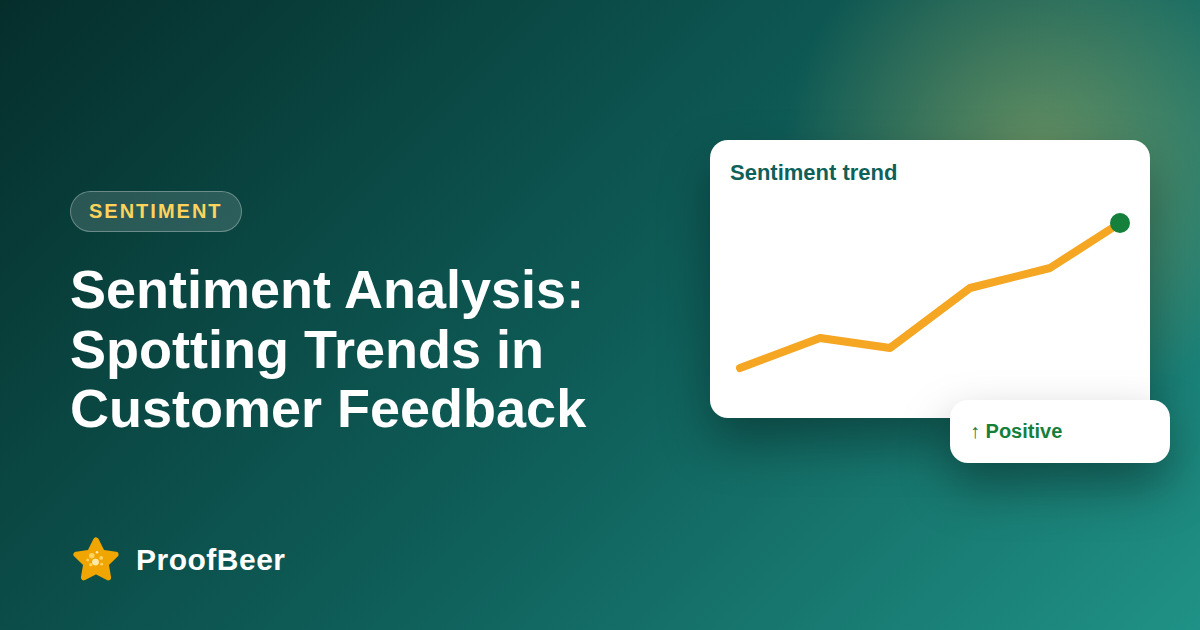
Sentiment analysis uses natural language processing to label customer feedback as positive, negative, neutral or mixed and to tag topics such as delivery, quality, service and price. Use it to find top complaints, celebrate strengths, flag urgent reviews and share trends with your team, and validate the results on a human-checked sample.
- Sentiment analysis turns thousands of comments into a manageable set of themes and trends.
- The common labels are positive, negative, neutral and mixed, and mixed reviews often hold the most useful detail.
- Topic tags such as delivery, quality, service and price show what customers are talking about, not only how they feel.
- The same method works on reviews, survey answers and support tickets, which helps you compare channels.
- Results should be validated on a hand-labelled sample because accuracy varies by tool, language and industry.
- Sarcasm, domain-specific words and very short comments are frequent causes of wrong labels.
- Use the output to prioritise fixes, train staff and borrow customer language in marketing copy.
- Protect customer privacy by removing personal details and checking vendor data terms.
What is sentiment analysis in customer feedback?
- It is a natural language processing technique that classifies text by the opinion or emotion it expresses.
- Most tools assign a label such as positive, negative, neutral or mixed, and some provide a score.
- Many tools add topic extraction, which groups comments by subject like delivery or customer service.
- It can be applied to reviews, survey responses, support tickets, chat transcripts and social comments.
- Tracked over time, the results show whether customer opinion is improving or getting worse.
What do the common sentiment categories look like?
- Positive example: 'Best product I have bought this year' clearly expresses satisfaction.
- Negative example: 'Terrible experience, nobody answered my emails' signals a service failure.
- Neutral example: 'It is okay' shows no strong feeling either way.
- Mixed example: 'Great product but slow shipping' contains both praise and a complaint and should be tagged with both topics.
- Mixed reviews are useful because they show what to protect and what to fix in a single comment.
How does topic extraction work with real examples?
- Delivery topics include comments such as 'arrived quickly' or 'package was damaged'.
- Product quality topics include 'excellent craftsmanship' or 'broke after a week'.
- Customer service topics include 'amazing support team' or 'no reply for days'.
- Price and value topics include 'great value for money' or 'too expensive for what you get'.
- Counting topics next to sentiment shows which themes drive satisfaction and which drive complaints.
How can you use the insights?
- Identify the top complaint by count and severity, and make it the first fix on the list.
- Celebrate and protect what customers love, since praise themes show your real strengths.
- Train support and operations teams using real examples from the data.
- Reuse customer language in website copy, ads and product descriptions.
- Share a short monthly trend summary with product, support and marketing leaders.
What pitfalls should you avoid?
- Sarcasm such as 'great, another delay' can be read as positive by simple models.
- Industry terms and product names can confuse general models unless they are tuned or checked.
- Overreliance on a single score hides context, so read samples from each theme.
- Customer text can contain personal data, so confirm how a tool stores and uses it.
- Models can be biased, so check results across customer groups and languages.
Step-by-step: how to do this with ProofBeer
Collect reviews, survey answers and tickets into one dataset with dates and sources.
Run sentiment and topic analysis with a tool you have vetted for privacy and language support.
Review the themes and read at least ten source comments for each major theme.
Share a short summary of findings with the teams that own each theme.
Fix the top issue and communicate the change to customers.
Measure sentiment and theme counts again after the fix.
Repeat monthly and keep notes on accuracy and tool changes.
Common mistakes to avoid
Metrics to track
Share of feedback with negative sentiment on each major theme.
Time from data collection to insight shared with the team.
Number of fixes shipped because of sentiment findings.
Change in average rating after a fix is shipped.
Agreement rate between tool labels and human labels on a sample.
Quick checklist
Examples and templates
positive, negative, neutral and mixed, each with one real comment
delivery, quality, service, price, ease of use, documentation
theme, evidence, owner, fix, date, result
- Read mixed reviews first because they contain both strengths and problems
- Always show counts next to percentages so small samples are obvious
- Remove names, emails and order numbers before sharing examples widely
How ProofBeer Helps You Grow
Sentiment and topic tagging features are available or planned for selected plans so you can see themes across your reviews.
Dashboards and exports let you view trends over time and share them with product and support teams.
Review data can be synced to Google Sheets or exported so you can run your own validation and analysis.
Frequently Asked Questions
What is sentiment analysis?
It is the automatic classification of text by the opinion or emotion it expresses, usually as positive, negative, neutral or mixed. Many tools also tag topics so you can see which parts of the experience customers praise or complain about.
How accurate is sentiment analysis?
Accuracy varies by tool, language, industry and text length. Validate by labelling a sample of reviews yourself and comparing the results. Expect weaker performance on sarcasm, slang and very short comments, and review disagreements to improve settings.
Can sentiment analysis find topics in feedback?
Yes, many tools extract topics such as delivery, quality, support and price and show the sentiment for each one. Check that the topic list matches your business, and customise or relabel categories where the defaults are too broad.
Is sentiment analysis useful for small businesses?
It is most useful when you have enough feedback that reading every comment is slow, such as hundreds of reviews. With smaller volumes, a spreadsheet with manual tags can be just as effective and gives you more context.
Does sentiment analysis work in every language?
Support varies widely. Major languages usually get better results than smaller ones, and mixed-language text can cause errors. Test each language you collect separately with a small labelled sample before trusting the output.
How should I act on sentiment results?
Start with the largest negative theme, assign an owner and set a fix date. Keep what customers praise, share findings with the relevant teams and measure again after changes to confirm that sentiment and ratings actually improved.
Conclusion
Sentiment analysis finds patterns in large volumes of feedback quickly, but it works best alongside human judgement. Validate it, act on the top themes and measure what changes.
- Google Cloud NLP docs
- Academic overview of sentiment analysis