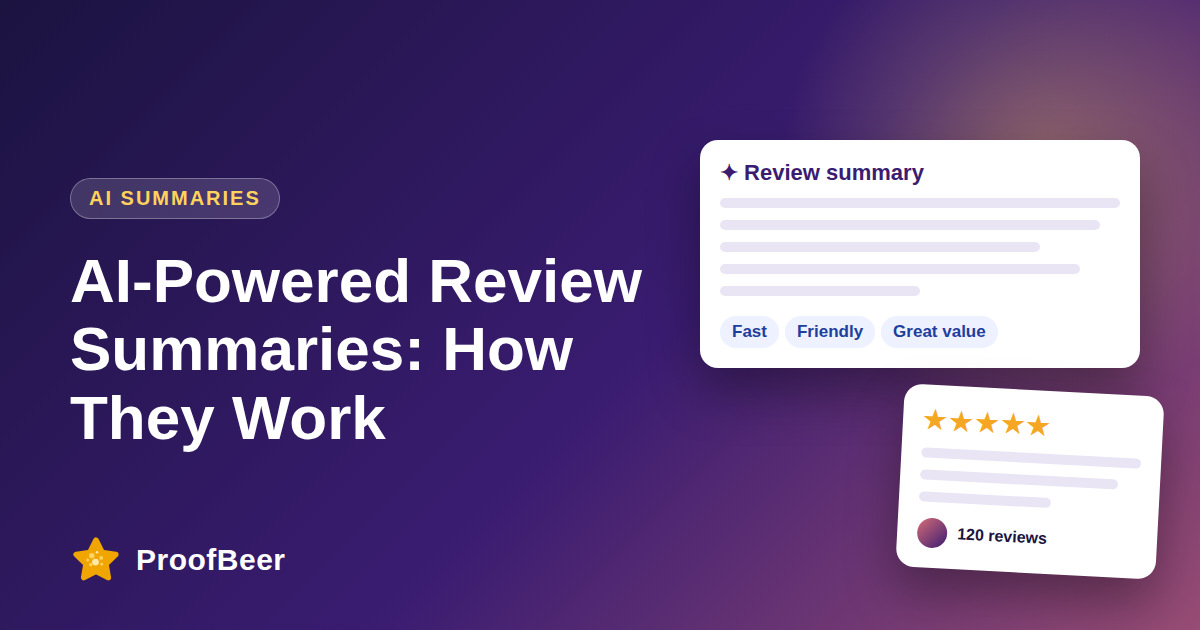
AI review summaries work in four stages: the tool cleans and tokenises review text, classifies sentiment, extracts recurring topics such as shipping or support, and then generates a short summary of themes with counts. They give faster insight than reading every review, but you should always verify them against source reviews and watch for bias, sarcasm and small samples.
- AI review summarisation combines natural language processing, sentiment analysis, topic extraction and text generation into one pipeline.
- A useful summary shows overall sentiment, the top themes, how often each theme appears and a few representative quotes.
- Every summary should link back to the source reviews so a human can check the claim before acting on it.
- Generated summaries can hallucinate, so treat them as a first draft of insight rather than a final verdict.
- Sarcasm, slang, mixed languages and small samples are the most common causes of wrong results.
- Use the output to prioritise actions such as fixing a recurring delivery problem or rewriting product copy in customer language.
- Measure accuracy by comparing the tool with a hand-labelled sample of reviews every few months.
- Disclosing where AI was used builds trust with readers and helps AI search engines judge the page as transparent.
What technology sits behind an AI review summary?
- Natural language processing splits each review into tokens and sentences so the software can work with clean, structured text.
- Sentiment analysis labels each review or sentence as positive, negative, neutral or mixed.
- Topic extraction groups comments into themes such as delivery, quality, support and price.
- A language model or summarisation step then writes a short plain-language overview of the themes and their balance.
- Better tools keep a link between each theme and the reviews that produced it, which makes the result checkable.
What does a good summary look like?
- The illustrative example below is invented to show the format, not real data: input of 500 reviews, overall sentiment mostly positive, top theme fast shipping.
- A good summary lists each theme with a mention count, such as shipping 120 mentions and product quality 95 mentions in the example.
- It flags problem themes separately, for instance slow support with 45 mentions of which most are negative.
- It includes one or two verbatim quotes per theme so readers can judge the tone for themselves.
- It states the date range and number of reviews analysed, which makes the summary citable.
How do AI summaries create business value?
- They help teams find recurring issues faster than manual reading, especially once review volume passes a few hundred.
- They support data-driven decisions because themes and counts are easier to compare than individual opinions.
- They let support leads see critical feedback early and respond before a problem spreads.
- They give marketers evidence-based copy, because the most common praise shows what customers value most.
- They free analysts to spend time on decisions instead of tagging comments by hand.
Where can AI summaries go wrong?
- Generated text can hallucinate, meaning it may state a theme or number that the reviews do not actually support.
- Models can carry bias, for example reading some dialects or writing styles as more negative than they are.
- Language and cultural differences change how praise and complaints are worded, so results may vary across markets.
- Small samples create noisy percentages, so a theme mentioned five times should not be treated as a trend.
- Review text can include personal data, so check the vendor's privacy and retention terms before uploading it.
What best practices keep summaries trustworthy?
- Keep source links with every theme so a person can open the underlying reviews in one click.
- Have a human review the summary before it is used in a decision, a report or public copy.
- Track accuracy by labelling a sample of reviews by hand and comparing the tool's answers.
- Update prompts and settings when the tool misreads a product name or industry term.
- Disclose AI assistance where it is used publicly, and publish the date and sample size.
Step-by-step: how to do this with ProofBeer
Collect recent reviews from your platforms into one place and remove obvious duplicates.
Choose a tool or model and check its privacy terms, language support and ability to link back to sources.
Run the analysis on a defined date range so the sample size is known.
Read the output and compare each theme with five to ten source reviews.
Verify any number or quote that you plan to publish or present.
Turn the top themes into actions with an owner and a date.
Repeat monthly and note changes in themes, so you can see whether fixes worked.
Common mistakes to avoid
Metrics to track
Agreement rate between the AI summary and a hand-labelled sample of reviews.
Hours saved per month compared with reading reviews manually.
Number of concrete actions taken because of summary insights.
Share of reviews assigned to a clear theme.
Time between a new problem theme appearing and a team member noticing it.
Quick checklist
Examples and templates
theme, mentions, sentiment split, best quote, suggested action
'Shipping theme checked against 10 source reviews, 9 matched.'
'Themes in this report were summarised with AI and checked by our team.'
- Always keep a link from each theme to its underlying reviews
- Do not quote a number from a summary until you have checked it
- Compare one month with the next so you can see whether fixes changed the themes
How ProofBeer Helps You Grow
Review data collected in ProofBeer can be exported so you can run your own analysis or summarisation pipeline on the full set.
AI-assisted analytics and summaries are available in selected plans , always alongside the original reviews for checking.
Dashboards and exports help you track themes over time and share evidence with product, support and marketing teams.
Frequently Asked Questions
How do AI review summaries work?
They clean and tokenise review text, classify sentiment, group comments into topics and then generate a short summary of the main themes. The best tools also show counts and link each theme back to the original reviews so you can check it.
Are AI review summaries accurate?
They are often useful but not perfect. Accuracy depends on the model, the language and the sample size. Test a tool by comparing its labels with a hand-labelled set of reviews, and always check important claims against the source text.
Can AI summaries replace reading reviews?
No, they should complement reading rather than replace it. Summaries show patterns quickly, but only a person can understand nuance, sarcasm and context. Read a sample of reviews behind every major theme, especially negative ones, before you make decisions.
Do AI summaries work in many languages?
Support varies by tool and language, and quality is usually strongest for widely used languages. If you collect reviews in several languages, test each one separately with a small labelled sample before trusting the results across all markets.
Are AI summaries safe for private customer data?
That depends on the vendor. Check whether review text is stored, used to train models or shared with third parties, and make sure your use fits your privacy policy and local data rules such as GDPR. Remove personal details where possible.
How do I start using AI review summaries?
Pilot the process on a recent batch of reviews, such as the last 100 to 200. Compare the output with your own reading, record where it is wrong, and expand to ongoing monthly use only if accuracy is good enough.
Conclusion
AI summaries turn piles of reviews into themes you can act on, but only when you keep the source reviews in view. Verify, record accuracy and use the results to drive real improvements.
- Google Cloud NLP docs
- Anthropic or OpenAI guidance on summarisation